
Module summary
- A blockchain is a shared ledger; whoever controls the private key controls the coins recorded against an address.
- Coins run their own networks, tokens live on someone else's, and stablecoins try to track a currency.
- Volatility changes the maths: a 50% fall needs a 100% rise to recover, and mistakes on-chain cannot be reversed.
How crypto works can be explained with three ideas: a ledger that many computers keep in agreement, a pair of cryptographic keys that prove who can spend what, and a set of rules for adding new entries. Once those are clear, the risks of crypto stop looking mysterious and start looking specific.
The ledger and the consensus rules
A blockchain records transfers in blocks, each linked to the one before. Thousands of independent computers, called nodes, hold copies and check that every new block follows the network's rules. Because they agree on one version of history, nobody needs a bank in the middle to confirm that a payment happened.
Networks reach agreement in different ways. Bitcoin uses proof of work, where miners spend electricity to earn the right to add a block; Ethereum uses proof of stake, where validators lock up coins as collateral and can lose them for misbehaving. The practical consequence is the same: confirmed transactions are very hard to change, which is excellent for security and harsh when you make a mistake.
Keys, addresses and wallets
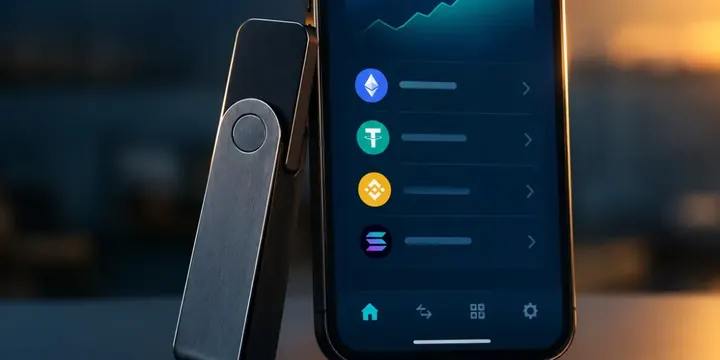
A wallet does not store coins. It stores a private key, a secret number that can sign transactions, and derives public addresses from it. Anyone can send to an address; only the key holder can spend from it. Most wallets back up the key as a recovery phrase of 12 or 24 words.
- Lose the recovery phrase and there is no reset link.
- Share it and whoever receives it can empty the wallet.
- No legitimate platform, support team or website ever needs it.
Coins, tokens and stablecoins
A coin is the native asset of its own blockchain: bitcoin on Bitcoin, ether on Ethereum. A token is issued by a smart contract running on an existing chain, so it inherits that chain's fees and security. Stablecoins are tokens designed to hold a steady value, usually one US dollar, backed by reserves or by other mechanisms. Our USDT module looks at the largest one in detail, and the Bitcoin module covers the first and most widely held coin.

Custody: platform or self-held
Buying crypto on a trading platform usually means the platform holds the keys and your balance is an entry in its database. That is convenient, but it is a claim on a company, and crypto platforms have failed in the past with customer assets missing. Holding coins in your own wallet removes that counterparty but makes you responsible for security. Many learners use both: a platform for trading, a self-custody wallet for anything held long term. Whichever route you choose, check the platform's licence in your country; the broker checklist applies to crypto platforms as well.
Prices, trackers and volatility
Because every platform has its own order book, there is no single official price. Aggregator sites average prices across venues, and many learners keep a live coin watch list on a price tracker to follow a few assets across the day. Treat those figures as indications: the price you can actually trade at is the one in your platform's order book, after its spread and fee.
Volatility needs its own arithmetic. With illustrative figures: $1,000 in a coin that falls 50% becomes $500; a 50% rise from there brings it to $750, not back to $1,000. Recovering from a halving requires a doubling. The crypto profit calculator shows the same effect once fees are included.
Costs you meet in crypto
- Trading fees, often split into maker and taker rates, charged on each buy and sell.
- Spread between buy and sell prices, which is wider on "instant buy" screens than in the order book.
- Network fees paid to miners or validators for on-chain transfers, which rise when the network is busy.
- Withdrawal fees set by the platform, sometimes different from the actual network cost.
The full picture across all three markets is in trading fees explained.
Rules and risks
Regulation of crypto is catching up but remains uneven. The EU now licenses crypto-asset service providers under MiCA; the UK has banned the sale of crypto derivatives to retail consumers since 2021; UK and EU retail leverage on crypto CFDs, where offered, is capped at 2:1. Beyond regulation, the main risks are price swings, platform failure, hacks, irreversible user errors and a large volume of scams aimed at newcomers. The scam module covers the patterns worth recognising.
Following one transaction from start to finish
Tracing a single transfer makes the abstract parts concrete. Suppose you move a coin from a platform to your own wallet.
- Your wallet shows a receiving address derived from its key. You copy it into the platform's withdrawal form and choose the matching network.
- The platform signs a transaction from one of its own wallets and broadcasts it, deducting its withdrawal fee from your balance.
- The transaction waits among other unconfirmed transactions until a miner or validator includes it in a block, generally prioritising those paying higher network fees.
- Once included, it has one confirmation. Each later block adds another; the coins appear in your wallet, and after enough confirmations the transfer is treated as final.
Each transaction receives an identifier that anyone can look up on a public block explorer, which shows the addresses, amounts, fees and confirmations. That transparency is useful for checking a transfer, and it also means your transaction history is visible to anyone who links an address to you.
Checking a crypto platform
The due-diligence approach that applies to brokers carries over, with a few additions. Look for a licence or registration in your country, not just somewhere. Read how the platform holds customer assets: whether they are kept separate from its own, and how much is in offline storage. Some platforms publish proof of reserves, cryptographic evidence of the assets they hold; it is most meaningful when it is paired with evidence of liabilities, because assets alone say nothing about solvency. Finally, note how withdrawals have been handled in past periods of stress.
Records and tax
In many countries disposing of crypto, including swapping one coin for another or spending it, can be a taxable event. Keep a record of every purchase, sale, transfer and fee with dates and values in your home currency. Platforms may not keep your history indefinitely, and reconstructing it later is difficult. Rules vary widely, so check the guidance from your own tax authority.
Smart contracts in brief
Some blockchains, Ethereum being the best known, can run programs called smart contracts. A smart contract holds funds and follows its code automatically: it can issue tokens, run a lending market or swap one token for another without a company in the middle. That opens up applications grouped under the name decentralised finance, and it adds a distinct risk. Code can contain bugs, permissions can let a small group change the rules, and connecting a wallet to the wrong contract can hand over control of tokens. Interacting with a contract is only as safe as the code and the people who can change it.
Questions from readers
Can a crypto transaction be reversed?
Not by the network. Once a transaction is confirmed it is final. Only the recipient can send funds back, which is why sending to a wrong address or network is usually a permanent loss.
Is my crypto safe on a large platform?
Size does not guarantee safety. On a platform you rely on its security, solvency and honesty. Check its regulatory status, withdrawal record and whether it publishes evidence of reserves, and consider self-custody for long-term holdings.
Why do price trackers show different figures from my platform?
Trackers average prices from many platforms, while your platform quotes from its own order book and adds its fees. Small differences are normal; large ones may point to low liquidity.
Sources
- UK Financial Conduct Authority, ban on crypto-derivatives for retail consumers (2021)
- EU Markets in Crypto-Assets Regulation (MiCA)
- European Securities and Markets Authority, CFD product intervention measures